I cruised west through the city listening to my San Francisco mix, starting with The Grateful Dead’s “Fire on the Mountain.”
Meredith’s words echoed: “The pieces tumbled in the puzzle box like magnets.”
The city was decked out for an All-American celebration. Stars and stripes adorned street poles and building fronts. Flags flew from car windows. A corgi in a red vest drank from a rubber bowl. All I knew of San Fran were hills, trolleys, and Alcatraz. And the Golden State Warriors. And the San Francisco Giants, who were home for a weekend series against the Braves. And the Alamo Drafthouse. And the Full House house. And the gold rush, which started on January 24th, 1848, an odd date to remember unless it was your birthday.
“It feels like home when I’m with your father.”
The flashing sign outside Chase Center promoted a Taylor Swift concert. There was a memory of pick-up basketball in our driveway when I was fourteen. I was the same height as Dad, 5’10” and growing. Spin Cycle had decided to take a break. Dad was halfway through a year-long sabbatical, as he called it, writing songs in his black notebook, everywhere: while pushing a grocery cart, at a restaurant, on a bench along a pond while feeding ducks, in between points of a basketball game.
“Time out,” he called that day we were playing to 21. It was 1996, the year before Red Rocks. I was 15. That made him 37, four years younger than I am as I write this. He and Mom had split. Meredith was gone. He’d bought a new house in Ann Arbor with far too much space for either of us. But it had a driveway, and a basketball hoop, and he was damned if he was going to let me beat him, even if it required frequent breaks to “write another line.” He was writing, I’ll give him that, but he was also gasping for air. I get it. He was 36 then. I’ve been there.
“Don’t look at me like that. The older you get, the harder it is to stay in shape. I feel like a leaky air mattress.”
“What’re you writing again?”
I passed him the ball at the top of the key we’d drawn with blue sidewalk chalk. He checked it back to me. “What’re your favorite soundtracks?”
I spun the ball over my fingertips. “Soundtracks?”
Despite his growing exhaustion, he hadn’t given up getting into a full defensive stance, legs bent, arms wide. “Soundtracks. Top Gun. Forrest Gump.”
“Those two, for sure. Footloose.”
“Yep.”
I faked right and drove left, the ball an extension of my hand. I’d done the same move the last three points. He saw it coming and stonewalled me. I dribbled backwards and reassessed. “Grease. I love Pulp Fiction. Pretty in Pink. Purple Rain. Dirty Dancing.”
His eyes lit up with each title. He nodded, then his face turned contemplative.
I continued. “Aladdin and The Lion King, right?”
“We might want to give Disney its own category. I ever tell you about the time I serenaded Meredith with ‘A Whole New World?’”
He was twitching his fingers in anticipation of my next move. I figured he’d expect me to drive hard right with no crossover or dekes. But then he might know I’d know he figured that. I’d plan to fake right and drive left again, only he might know I’d know he’d know that. There was a pull up jumper, a move I was slow executing but went in half the time. “You did. On that boat on Lake Hamlin, right?”
He swiped at the ball and knocked it away. I sprinted to it and recovered. He wagged his finger at me like Jordan impersonating Mutombo. “Hamlin Lake, and yes. Beautiful. We were at the beach all day, sunburned and tired. We’d had ice cream from the local shop. Triple scoops with enough sugar to propel us onto a boat to do nothing other than cruise on the water. I sang to her when the sky turned from day into night. She cried. We embraced. I’m a sap. I love it there.”
I faked a jump shot, which almost sent him soaring past me. He hung on his toes and sunk back into his position. There’s a question not enough interviewers ask Dad: “Did you play any sports growing up?” As a matter of fact, he did. He was All-State for basketball, scored 1,478 points in his career, leading his team to the Final Four his senior year. There’s a whole world where he’s not Brett Carradine the rockstar, but Brett Carradine the full-ride college basketball star (who probably ends up in a cubicle crunching numbers like me). Only, Dad would’ve never ended up in a cubicle.
“You still love her,” I said. It was cheap. I knew it’d catch him off guard, which it did. I drove hard right around his flailing reach and laid the ball off the backboard, catching it after it dropped through the net. “7-4.”
I bounced the ball to him. “Sorry about that.”
He rolled the ball in his hands. “Nothing to be sorry about. Never apologize for speaking the truth. I love her. I always have. Always will. I wish she loved me.”
“Maybe she does. Let a bird fly away. If it comes back…”
He dribbled the ball once, twice. “And sometimes they don’t come back.”
I drove through San Francisco with wet eyes, Steve Miller singing “This here’s a story ‘bout Billie Joe and Bobby Sue.” Dad’s biggest flaw was his biggest strength: his heart.
“And sometimes they do,” I told him back on that basketball court, which I haven’t set foot on in twenty years. Is the net still intact? “What did you tell me? When you know, you know. Right?”
“I did say that.”
“Then why this new one?” I asked him about the bimbo who had no business with my big-hearted father. “She’s awful, Dad. Seriously. I’m sorry, but she is. She’s not smart. She doesn’t understand your music. And she’s… unkind.”
“Fender.”
“And she doesn’t understand you. Even if Meredith never returns, having no one is better than this one.”
He chucked the ball back so hard it hit my chest. “Hey.”
“Clearly you’re too young to understand the concept of a rebound .” He cracked his knuckles with the palm of his hand.
There was another memory behind that memory, the one that still didn’t make sense, where Dad and I argued over who would take care of him. He denied the latest update from his doctor, said to leave it alone. I said I would move back home to help Meredith. And he snipped about why bother doing that now after not caring for the last decade. Meredith said maybe it was a good time for a walk. And I did just that, straight to my car and back to Georgia.
If someone were to ask me point blank, “Why don’t you and your dad talk anymore?” my answer would be a frustrating, “I forgot.” Because living is hard, and admitting mistakes and making difficult decisions is even harder. It requires courage which I’ve never had. Or maybe I did, but I just didn’t know how to use it.
My knuckles cracked around the steering wheel.
Back to basketball.
I sized up the rim, licking my lips. I elevated and released the ball before he could get a hand up. Nothing but net. I jogged over to the ball and rolled it slowly over to him. “Hard to understand the concept when you’re this good.”
“Shut up.”
We were both sweating and grinning. “What’s your favorite soundtrack?”
“The Big Chill. That’s what I’m trying to capture. How does the music inform, support, and catapult the movie.”
“Can I listen?”
“Of course. Always. You’re my guy. It’s not ready yet, but you’ll be the first to hear.”
I turned the music up loud, opening the windows for others to hear. Meredith’s lines played on repeat:
We’re always making decisions for people based on assumptions that might have nothing to do with how they actually feel. Let them decide.
It’s June. The air’s clear. It’s 65 degrees and sunny.
There’s a world where he doesn’t become a global superstar.
I promise you; it’ll happen when the time is right.
When it’s that easy, you tend to not think about these things.
I didn’t realize I was waving at people until they waved back. You get what you give. Someone told me that once. Or I’d heard it in a song, which was the same as someone telling me things. At a certain point, I subscribed to the concept that putting out good vibes into the world eventually reciprocates itself. Only it was inconsistent, contingent on how positive my life was going at any particular time.
Cases in point:
Pre-Laramie I would’ve rucked around San Francisco happy-go-lucky and naive, waving and assuming people had my best intentions at heart. I’d have missteps when I considered Dad and the fight we had, and how lonely I felt in a world full of billions of people, crying at random times and not understanding why. But I’d ignore the negative thoughts, visibly shaking them off so I didn’t have to think about the bad. How was that going to get me through the day? It was better to bury it and smile and put happiness into the world, however fabricated.
With Laramie, I was happy. I’d found someone who understood me and who I understood. There was love there. The unspoken connection between two people who don’t need to speak to know a truth. Only I was unsettled from my past, the buried trauma we all have, and no matter how happy she made me, that still needed to be dealt with. Was it the cause of our split? Who’s to say? Life happens. People move in different directions. Sometimes they circle back. Sometimes the flame burns out. Judd Hirsch tells Margaret Colin in Independence Day, “There’s still love there, I think.” And she says, “Love was never the problem.” I’ve finally stopped wondering when love ended for Laramie. The thought tries to come up, but James tends to whisper, Not now, Buck. Maybe not ever. Trying to answer an unanswerable question is a fool’s errand.
Post-Laramie was the same as Pre-Laramie, only my heart was broken, and the fabricated happiness hurt more. I wouldn’t have seen the light of day in San Francisco for the days and months, or really the first year, after Laramie. It was all woe is me, and bear with me. I should’ve started this whole damn thing with me waking up in my bed and saying, “I fucking hate my life.”
Post-Laramie plus therapy can best be described as finally being able to listen to the songs we listened to together without losing my shit. And learning coping mechanisms to handle the bad times when they came up, so that they only lasted as long as they needed to. It was being open to the thought of visiting Dad, with only my stubbornness in the way, not my feelings. The vibes would have started, with waving to strangers as a first step I recognized and discussed with James and my therapist as signs of putting positive energy into the world again.
Post-Laramie plus therapy plus Dad’s scavenger hunt road trip had me genuinely waving at folks on the streets of San Francisco without thinking about it, shocked by how natural it felt to be happy.
(Tears came when I wrote that last bit. Unexpected, as they tend to, a well of them overflowing when I least expect it. Sitting with my feet up on an ottoman in my hotel room, laptop on my lap, The Big Chill soundtrack tuned to The Temptations singing “My Girl.” Not bad tears, none of them are. They’re happening for a reason. Once you figure out why, what that release valve means, there’s healing that can happen. I’m writing this before I head out from San Fran, after my fun at the ballpark with Earnest Jr., as if I have all the answers. I don’t. Just stating my progress in my journey to better mental health. I hope it helps.)
I muted the radio for long enough to make myself present, to prepare for whatever was waiting for me at the address on the yellow post-it note. In that moment, I realized my heart wasn’t clenched. My skin wasn’t terse with stress. What was going to happen was going to happen, as long as I continued onward. The address on the yellow post-it note led me to a gas station with a car wash off to the side. A wooden sign stuck in the ground said, “El Don’s Tacos has moved” and listed an address on Judah Street.
Two men were lying on the pavement, half covered with dirty blankets. I’d never understood the word weathered as much as I did then, looking at their haggard skin. There was a section of grass next to the pavement that they could have slept on. Used needles laid in a pile inside an open pizza box. I smelled urine. And shit.
And life is weird. I’m writing this book about Dad, and could make up anything, really, only most of the time life’s crazy enough without fiction. That’s what I saw, and had heard about San Francisco from friends, and knew existed around the city, and perhaps was why El Don’s Tacos had moved to Judah Street.
There was nothing to do for the men passed out on the pavement. I didn’t know their story and never would. I drove to the address on Judah Street. It was another gas station, the El Don food truck parked roadside in the front corner with a line of people waiting. Above the menu, there was a hand-lettered sign, CASH ONLY. While I waited, I chatted with a guy about the truck, about San Fran, about my trip. He wore paint-stained jeans and shirt. A Giants hat. A wispy mustache he’d been growing for either three days or three years.
“You’re what, driving around the country, learning about music, memories, and mental health?”
The sun couldn’t have been shining brighter. My sunglasses barely blocked the rays. My skin soaked it in, happy for vitamin D.
“When you put it like that… yeah, pretty much.”
“Rock on, man. You know what you’re ordering?”
I didn’t. He went into detail on the menu, highlighting the tacos, especially the pastor, the refried beans, and said the red sauce would light my ass on fire.
“Anything else?”
“You’ll want three, but order four.”
“Got it. Thanks.”
When he ordered four barbacoa tacos, I stepped up and told the woman in the window I’d pay for his order. He tried not to let me, but I insisted.
I ordered my four pastor tacos with a side of refried beans. As Dad would say, we proceeded to shoot the shit at a picnic table in the shade. His name was Pat. He painted houses with his brother, Phil. He had two kids, both enrolled at San Jose State. Thomas was majoring in business administration and currently working as a paid intern at Sysco. Tabbie started in journalism but had recently switched to public health and had hopes of saving San Francisco.
“I don’t have the heart to tell her it’s been like this since at least the 80s. They’re good kids. You have any?”
“I don’t.”
He finished his pineapple Jarritos and held his hand out to collect my empty Styrofoam container. “Told you they were good.”
“No shit. I’m guessing you also know where Earnest Ernest is?”
He tossed our trash and wiped his hands on his jeans. “I wouldn’t be a local if I didn’t. It’s not far from here. Swing back down Judah, pass over Sunset, right on 33rd, and then just past Noriega. Tell EJ I say hello. Nice kid. Probably your age.”
We shook hands and fuck if I wasn’t belly-full and smiling ear to ear when I attempted to follow his directions without GPS. I almost punched it in when I drove past 33rd, but I turned around, hooked a left at 33rd, and slowed when I approached Noriega.
“What exactly am I looking for, James?”
Dude.
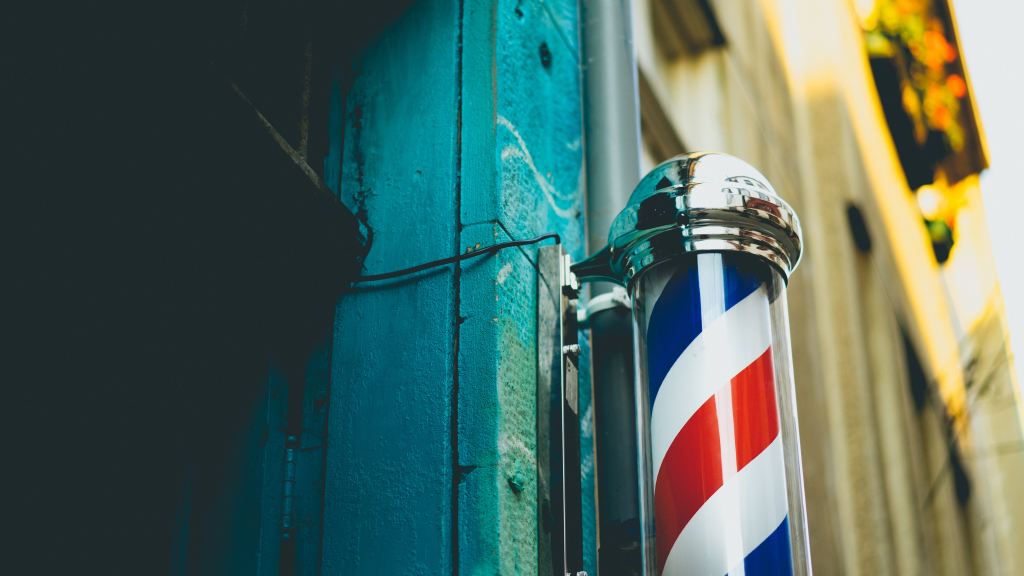
Meredith’s story came back. “A blue awning with the working barber shop pole with the rotating red, white, and blue stripes.”
I pulled up to the curb and read the sign above the pole: “We don’t cut hair, but we do sell scissors.”
 Mike Writes
Leave a comment