
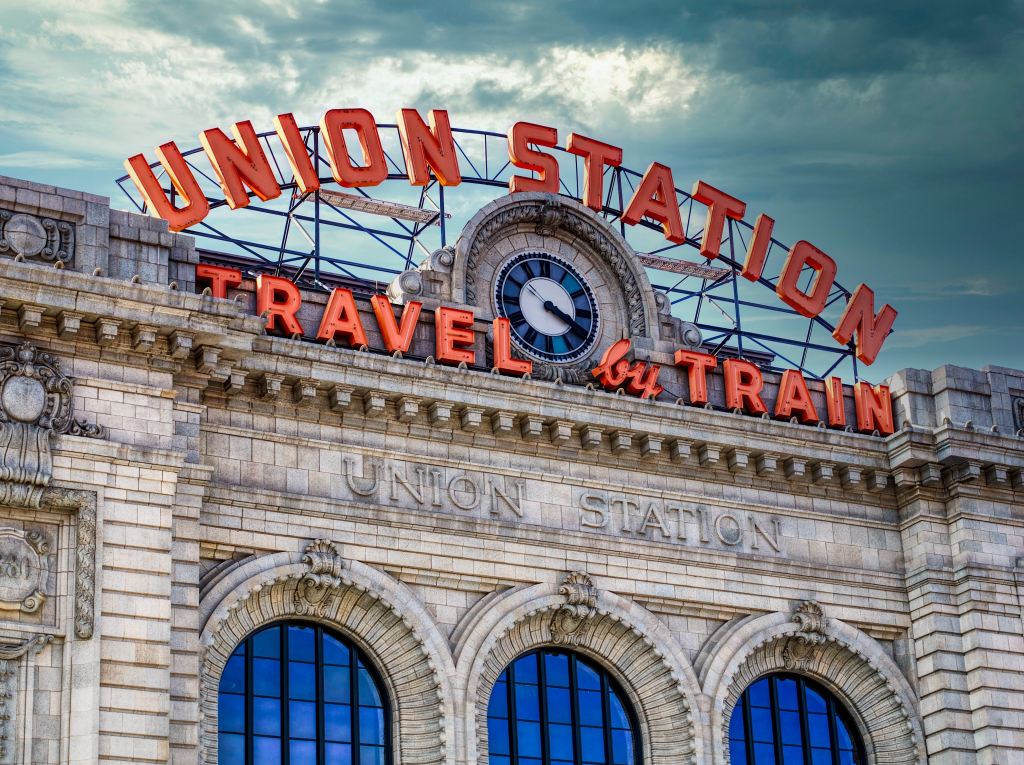
Deacon McCurdy lived in a condo off Larimer Square. He was a “walk with me” sort of guy, a perpetual ball bouncing from place to place getting things done. By the time I left my hotel, rode the 16th Street MallRide shuttle, and arrived outside his condo, he stood next to the curb in gray slacks and a “Beatles or the Stones?” t-shirt. An army of gray hairs had joined his mustache to form a wise beard. His dapper black hair was gone, shaved smooth and shining under the morning sun.
“Fender mother fucking Carradine.” He opened his arms and pulled me in. For a man in his 70s, the clench was firm. And real. “Walk with me.”
He led us through the streets of Denver towards Union Station. He walked like he talked: smooth and with a sense of purpose. To see Deacon lost and confused was to see the end of the world.
“How have you been?” I asked. “It’s been, what, fifteen years? My graduation?”
“Too long, I reckon.”
He signaled halt at Market and 17th. Morning foot traffic buzzed past. I thought of my home office, of piling paperwork, the appointments waiting when I returned from my “sabbatical”, of colleagues judging, of how I spent fifteen years balancing books for clients, and made a decent living doing so, and yet in that moment while lengthening my steps to keep up with the spry Deacon I couldn’t remember a time I’d truly thought, “Damn, I’m so happy this is what I ended up doing with my life.”
We turned a corner. Deacon marveled, “There we go.”
Union Station stood a few blocks down. The great orange letters spelled out “Union Station, Travel by Train” above the stone building. Three windows glowed blue in the sunlight. A clock behind the sign ticked the seconds of our lives away. How many more did I have?
“You think you’re staying out here?” I asked.
“For the foreseeable future and beyond, you can find me here.”
The sidewalk turned into a block of white stones outside Union Station. I envisioned horses and carriages and the old west. A father and son spun circles on unicycles, making balloon animals for the children who weren’t playing in the splash pad to the left of the building. The sound of the spraying water mixed with laughing children to make a track I’d put on an album.
Deacon opened the door to Union Station.
“I have to go see a guy about the thrift shop. You know the three greatest sounds in the world?”
“Yeah, breakfast is served. Lunch is served. Dinner…”
“No, no, no, no! Anchor chains, plane motors, and train whistles. Enjoy the vibes.”
He hurried down the right side of the great hall, a mezzanine level with white columns ringed with lights, wooden picnic tables spread around in food hall style, and seating areas with plush chairs plucked from a 50s movie set. Restaurants and shops ran around the perimeter. Pigtrain Coffee. Snooze. Mercantile. Milkbox IceCreamery. The Crawford Hotel. I regretted my hotel decision before remembering Larry saying, “It’s a bed, a toilet, and a shower. How long are we staying? A day? Stop your complaining, Paul, and go to fucking bed.”
I popped out the back doors to breathe in the pungent iron of the train tracks. The train filled with folks toting luggage. It read airport on the destination screens above the windows. A woman in white shorts and a black blouse resembled the too cute for me woman, but when she turned it wasn’t her. She was even cuter than too cute for me. She waved to a guy in a tank top emblazoned with Steve Winwood’s face and carrying a Marmot backup over one shoulder. He rushed to her, kissed her on the cheek, and they boarded the train like the happiest damn couple on the planet.
Was the too cute for me woman still in Kansas City? Or had she matriculated down the road to her next destination? St. Louis. Chicago. Detroit. Honolulu? Should I make it back that way before the 4th, would she be there? Had she been a figment of my already too active imagination? My female Tyler Durden? Did she mozy rather than matriculate? Was her form of transportation wherever the wind blew?
And I’ll stop here to say that I’m writing this largely in real time, or at least in hotel rooms and in cafes when I have down time. If I knew what or who this woman was, I’d tell you. Unfortunately, I don’t. If I knew for a fact she was imaginary like my friend James, and used as a coping mechanism and tool for healing, I’d tell you. As it currently stands, my best answer is time will tell.
“Yeah, I’m never seeing her again.”
I stood in line at Pigtrain coffee, fiddling with a folded gas station receipt in my pocket while the guy in front of me asked the barista if they could make his latte with one part soy, one part almond milk, and one part coconut milk.
“If you can’t make it, I’m not going to order it.”
“We don’t have coconut milk, sir. We can do one part soy, one part almond, and you can purchase coconut milk elsewhere. Does that work?”
The lack of color in his face made it seem like this was an everyday conversation. “And how do you suggest I measure the one part coconut milk once I purchase it elsewhere? And if I actually measure it properly, how do I go about deconstructing the already frothed soy and almond milk poured and mixed into my latte? Or do you think I should simply buy coconut milk elsewhere and pour it cold into my latte like a fucking neanderthal? Look at this guy. He’s just as confused as me. Why he’s looking at me like that, on the other hand, might be something he reconsiders fast before he wears the latte you haven’t made for me yet.”
I raised my hand like that would stop this fever dream building in front of me. This wasn’t my specialty, dealing with extreme douchebags. I tended to be patient and see the other side. Maybe he’d had a bad morning. His son missed the bus and he had to drop him off at school which put him behind schedule. Now he was late for work, rushing, and just wanted his latte before his big presentation which he now had half the time to prepare for. Maybe he wasn’t an extreme douchebag. Or maybe people are who we think they are.
I know how Dad would’ve handled it, with kindness and wit, and in his younger days, a forearm to the guy’s throat until he apologized to the poor red-faced girl behind the counter.
A switch clicked. James chuckled.
“Sir, the only thing I’m confused by is why they haven’t kicked you out of here yet. I’m sure the police officer over by the salon can help you figure out how to blend coconut milk into your soy and almond latte. Or, I don’t know, just order a regular fucking coffee so the rest of us can get on with our day, too.”
My heart wasn’t handling the encounter well, thudding like a cowbell in my chest. I played it cool on the outside, not breaking eye contact and fighting the smirk trying to form on my face. Smirks get you punched in situations like that.
I got punched anyway.
He didn’t floor me, but the fist to face sent me crashing into the coffee mug display, sending mugs and bags of coffee flying. I heard them break and felt like a jerk. All I had to do was keep my mouth shut.
“Learn a lesson from this, asshole,” the guy said, massaging his knuckles. “And you. I thought Pigtrain was better than this.”
He strutted out with no latte and hopefully a broken hand, as hard headed as I could be. In the movies karma would smack him in the face in the form of a truck swerving off a road and flipping over a bridge onto him while he fished in the creek below. In real life jerks punched people all the time and went about their life with no repercussions.
“Are you okay?” several people asked.
Paul Simon played from the Pigtrain speakers:
If you’ll be my bodyguard
I can be your long lost pal
I can call you Betty
And Betty, when you call me, you can call me Al
A woman in bright spandex helped me clean up the shattered mugs. One bag had burst and shot coffee grounds across the floor. Cell phones picked up our efforts to clean my mess. It wasn’t my mess, but it was. They’re all your mess when you stick your head where it shouldn’t be.
“What the hell happened to you?” Deacon said, holding two cups of coffee.
My right cheek and eye throbbed, a pain I knew would grow into a whopping migraine later.
“I’m really sorry,” I told the barista.
She held up a small piece of cardboard. “No, thank you. He comes in here all the time and acts like that. Only this time he left his business card.”
“Do you mind?” I held out my cell phone.
“Be my guest.”
I snapped a photo of Don Otto’s business card, pocketed my phone, apologized again, thanked the woman who helped me clean, and grabbed a coffee from Deacon.
“How bad is it?”
“Maybe cancel any dates you had scheduled out here. Let’s get away from the damn cell phones.”
We left Union Station and made a pit stop at Larrisa’s Café. I stood outside watching traffic wait at stop lights through a squinted eye. Wafts of bacon came from the café door when it opened and closed. Deacon came out with an ice pack.
“Learning to fly but you ain’t got wings. Here. Got some blocks to go.”
The ice pack stung cold on my swelling eye socket. It also cooled the sweat from walking in eighty degrees five thousand feet closer to the sun.
“First time I’ve been punched. Not as cool as the movies make it seem.”
“No, it rarely is. Maybe your character grows, though. You learn something. It propels the plot while leaving a nugget for shenanigans later.”
“I did get his business card.”
“A wonderful detail to hold onto.”
We steered north down Blake Street. Men in suits swerved around a gathering of homeless people sheltered under a blue tarp next to a 7-Eleven. We didn’t have to swerve because Deacon had already led us off the sidewalk and into the road and back onto the sidewalk, lickety split. A biker in office clothing and wearing a backpack whizzed past my face. The ding of the bell rang an expletive.
“Don’t get in your feelings about it. Homeless have been here for decades. They have shelters. Yes, they’re overrun and will never be enough. But they’re available. They just don’t provide the freedom to live a certain way. Inject certain things. Nothing is ever perfect. It gets worse during warm weather.”
“You ever pay them?”
“I have. And I do. Fact of the matter is it’s rewarding what I consider bad behavior. Case in point, and then I’m telling you about your Dad because you don’t need to hear me lecturing.”
“Although it’s kind of nice to hear it again.”
I patted him on the back and we smiled. Sometimes life gets it right.
“A hearty hear hear to that.”
A bus sat at a stoplight like a fat metal carrier pigeon. An advertisement for Old Spice Deodorant was painted on its side. I remembered being young and wanting to use the fancy gel deodorant Paul Newman used, the stuff that smelled like a bonfire on a beach. I snuck into each band member’s toiletries to sample their deodorant at the same time, layering them in my armpits. The rash that formed, red and bumpy and itchy, so bad I couldn’t use deodorant for a week.
“No,” he said, his legs pistoning like a machine. “Falling Rock Tap House used to be there, by the way. One of our go-to spots after a show back in the day. No, I got to know a guy named Horace who lived on the streets. Took shelter in his sleeping bag and tarp tent off Larimer by me. I’d go out with cash on hand in case I saw him. Or I’d bring him water and granola bars. The occasional burger or chicken sandwich. He was kind and grateful. I asked him if he could work. He said yes. I double checked, emphasizing could and would. He said ‘Absolutely. Thank you, Deacon. Thank you. I won’t let you down.’ And I let him into my condo and he used my shower and dressed in the slacks and shirt I’d bought him. My barber, Tony Alongi, trimmed him up, turned the grizzled hair and beard into a damn fine looking gentleman. He had a gray scar along the side of his head from a ricochet bullet that carved a trough through his skull and left his brain open so the whole damn world could see it. Or just his Vietnam platoon mates carrying him through the jungle to the medic. Turns out you can heal that wound but not the part where he couldn’t stand to be inside enclosed spaces overnight. The shivers would come and he’d damn near have a heart attack.
“I tell him, ‘Horace, we’ll get you a job, and insurance, and a little trailer to live in outside of town. That way you can have shelter from the storm when it comes, but an open door and an awning and fresh air to sleep in. Hell, I’ll buy you a hammock as a housewarming gift. Until then, I tell him, he can live with me.
“Horace gets his interview at Safeway. Guy I know is the general manager. Good guy. You might’ve met him. He played bass in the Steven Brooks Band when they opened a few shows for Spin Cycle. Not a lifelong musician, but enjoyed the ride when the state fair came through town. He gives Horace a shot, and Horace doesn’t let me down. Gets a job stocking shelves. Part-time at first, but damn if he’s not the hardest worker in the store. Customers are going to the front desk giving him compliments. He’s so helpful. He’s so friendly. He gets full-time. My friend is happy. I’m happy. Horace is happy.
“A month goes by. Two months. The night terrors haven’t faded, but I notice Horace shivers less at night. Snores more, for damn sure. You’ve never heard a man snore like Horace, and you lived with your old man, who could wake the dead with his honker. He’s on the right track, is what you and I both know because we’re sensible and arguably responsible, and from everything I’ve heard about you, fairly successful. We also know it’s a long road to hoof. Horace does, too, because it turns out he’s brilliant. Possibly too brilliant for his own good. Was on a track to get into military intelligence. Top of class type of guy. Until he got shot in the head. Maybe he never had patience. Or trust. Maybe he once did and it all vanished with his leaking brain matter.
“What happens then is he sees his paychecks and knows within seconds how long it will take him to get the trailer on the land outside of town. To swing in a hammock with fresh air. The time it will take is years, not months, and not the hours he needs it to happen before he goes insane. I’m with him when this is happening, the mental math, his cracked lips moving while he calculates. What he’s doing is comparing his Safeway pay to the money he collects on the street from begging.
“‘I’m really sorry, Mr. McCurdy,’ he tells me, and damn it if my heart doesn’t shatter. I want to make a wish for this man, this falling star, Horace, to make the right decision, to not panic.
“I tell him I’ll do whatever it takes to supplement the difference in pay, but he won’t have it. He’s too proud. He appreciates what I’ve done. Asks me to inform my friend of his decision. He got embarrassed then and stripped out of the clothes I’d bought him, then and there, down to his skivvies, and put his stained jeans and sweatshirt on. He grabbed his sleeping bag and backpack. I thought he was going to hug me, but I saw the moment his eyes knew they would burst if he did, so he left.
“He moved away from Larimer. I checked the shelters to see what I could find out. They said he’d come in a time or two, but not much more. After time no one saw him. I stopped looking. Heartbreak comes in many forms. I’ve experienced more than I’d like, which is none. Sometimes it carves a part of you that might heal, but it never grows back. That’s Horace, wherever he may be.”
I didn’t know what to say. Not because I hadn’t seen Deacon in years, but because what do you say to someone who was still hurting?
Be curious.
“Where did that come from? The urge to help people.”
We were stopped at a light across from Coors Field. The Rockies were in Los Angeles for a weekend series. The stadium loomed like a colosseum waiting for gladiators to march through the interior gates. I’d visited Denver years ago for the American Accounting Association Conference. Dad’s words, always echoing. If you’re in a different city, check the ball schedule. Watched the Rockies launch five homers through the thin mountain air in a 12-3 victory.
“That’s Ms. Sally McCurdy. We were a house for folks when they had nowhere else to go. Ms. Sally did the cooking. I was in charge of laundry. Supplementarily, Fred Rogers and Casey Kasem.”
The ice pack didn’t last long with my face baking under the sun. It’d melted into a plastic sack of water. My pulse throbbed in my eye socket.
“He read one of my letters on-air, you know? Casey Kasem. That was his thing, reading letters from folks spreading love to friends and family across the world. I’d started the grind then. This was ‘72, shit, ‘73 at the latest. Long before I met Brett. I was living in Boston, bussing tables at clubs, meeting people. Coming in early to help wherever I could, but really to meet the bands and the agents. In walks who you know as Aerosmith, and I knew as the dudes who I got stoned with while watching Scooby Doo after a show. And Steven Tyler says, ‘Hey, man, do you know who does the voice for Shaggy?’ None of us knew before we got stoned. We damn sure didn’t know after. ‘Fucking Casey Kasem.’”
“Fucking Casey Kasem,” I said, because it sounded fun to say out loud. And it was.
“All I did now and then is consume music. He was newer on the radio scene. Started in, I guess it was ‘70, doing his American Top 40 program. Reading those letters that had me tearing up in my tiny apartment. Momma and my sisters stayed in Birmingham. I took the first club job in I could find in a bigger city. Atlanta might’ve made more sense because it was closer, but I wanted to be far away so I couldn’t shoot back the moment I got homesick. Moving away from home makes you feel all sorts of emotions. Helps you grow stronger.”
I thought about Dad’s solo career that had me living with Mom and Matt, the stepdad who tried way too hard. When I left for home for school, the only emotion I felt was relief. And years later, guilt for no particular reason, except maybe terrible communication with those closest to me.
“Here we are.” Simply Self Storage took up the entire block across the street. Hundreds of white containers all full of some sort of memory. A tall chain link fence surrounded the facility. “So I type a letter to Ms. Sally and my sisters. I make a copy and send one to them back home and the other to Casey Kasem’s office in New York. I have no expectations that he’ll read it. All I know is he signs his show off by saying, ‘Keep your feet on the ground and keep reaching for the stars’, and I damn sure know I’m working hard to find success, and it can’t hurt to dream about sharing that on-air with my family.”
We’d hit noon on our walk. Life moves, the earth revolves. The sunlight reflecting off the white storage containers could blind you from a mile away.
“Life gets so busy that I forget about the letter. I’m working daytime at a record shop, and nighttime at the club. Boston ain’t cheap, Buck. Grinding away. One night I’m hanging with Aerosmith, eating macaroni and cheese out of a Styrofoam bowl, listening to the top 40, when what do we hear over those speakers? ‘This letter comes from Deacon McCurdy, who writes from Boston, Massachusetts to his family in Birmingham, Alabama. Ms. Sally, Amanda, Tracy – Deacon wants you to know that even though he’s far away in Boston working hard to make it in the music business, he’s still thinking of you every day. One day, he’ll be working with bands and touring around the world, and he will make sure there’s always a stop in Birmingham on every tour. Until then, he loves you dearly, and wouldn’t mind if you hug your dog Winston for him. Ms. Sally, Amanda, Tracy – here’s Family Affair by Sly and the Family Stone.’”
I paused, cringing internally at the mixtape I made in middle school for Cindi Lauder, headlined by Tiffany’s cover of “I Think We’re Alone Now”.
“What’d Steven Tyler say?”
The look on Deacon’s face. My face hurt to laugh, but I did it anyway. His eyes scrunched up, his mouth twisted to the side, and he said, “What the fuck, Deacon?”
“Really?”
“Not really.” His laugh came out as a sigh. “Or maybe it was, but facetious. He was kind. Said it was sweet. That he wished more people gave a shit about others.”
Deacon checked his phone and then entered a code into an electronic keypad on a metal gate. The gate hummed and slid open.
“And Mr. Rogers?”
We walked straight down a corridor between containers, hooked a left at the sign for 180-189, and stopped in front of a medium-sized unit with a wide rolling door locked at the bottom with a padlock.
“Mr. Rogers was Mr. Rogers. Nicest guy in the world, and definitely in showbiz. Paul used to get under your Dad’s skin, calling him that. Any time Brett did something nice for someone, Paul would scoff, ‘Okay, Mr. Rogers.’ Something as small as holding a door open for someone entering a hotel. Or offering to help someone carry their luggage. Or unload groceries. Or simply asking questions to get to know a person. Your Dad didn’t think about things like that. It was effortless. And Paul, well, Paul was an asshole who needed to be paid to shake a person’s hand, not to mention ask them how their day was going. Give me a hand with this will ya? Can walk for days, but back ain’t what it used to be.”
He gave me the key. I bent over and felt the creak in my back. If mine hurt from that motion, what did Deacon’s feel like? Where would I be at 71? Would I even be around? I removed the lock and lifted the rolling gate. A cloud of must greeted us. The sunlight cut rays through the darkness. For many Spin Cycle and Brett Carradine fans, a choir would have sung. Or Brett and Paul harmonizing the chorus to “Damn Your Nuns”. This was like walking into the glowing briefcase in Pulp Fiction.
“Holy shit.”
“It ain’t exactly a thrift shop, but you’ll find what it is you’re looking for.”
He flicked a light switch. The unit came to life. Framed posters from various tours. Stacks of plastic egg crates full of film reels, cassette tapes, and CDs. Boxes on boxes on boxes. The right wall was dedicated to boxes with photographs. Hundreds of them, the kind you had to snap with a camera and have a store develop for you. They still develop photos, but when’s the last time you touched a physical copy of a photograph?
There was one of Paul and Larry and Deacon sharing a laugh over a cigarette.
There was Dad in a tank top on a toilet, shorts at his ankles, middle finger raised.
There was me across from Dad at the tour bus table, playing Battleship. We wore the same tank top, navy blue with the Detroit Tigers logo. My toothpick arms appeared to be miming an explosion. Dad’s face mimed exaggerated shock.
There was the band in front of the Rocky statue in Philadelphia, raising their arms like the Italian Stallion.
There was the band at Sun Studios in Memphis, bright-eyed and bushy-tailed, kids at the original playground.
There they were at a baseball game, beers held high, what looked like ivy on the outfield walls behind them.
There was a rubber banded stack of landscapes, scenery, buildings, and architecture. A note tucked under the rubber said, “Please give to Heather. –BC.”
There was another rubber banded stack under that with the same note. The photos were all of the band on stage, working their black magic. Paul and Dad at the same mic, faces red with effort. Larry wearing a black sweat band on his forehead, drumsticks blurry. Meredith in a red dress, singing background.
I set the stacks aside.
There was Meredith and Paul stern-faced and deep in conversation. She was more beautiful than I remembered. Two thin sections of her hair braided on one side of her head. Paul wore stubble and a scowl. I hated to admit it, but I was nervous to visit him. I didn’t know the order to this quest, but he was on it, the Smaug to Dad’s buried treasure, the lost recording. Last I knew he was still in Seattle.
There was Dad with the Harvey Keitel’s brother lookalike, outside the shop where I started my trip. Both men weren’t old yet, but they weren’t babies either. They were my age, arms around shoulders, the types of smiles friends make when they’re reunited after years apart.
“Dad always said he liked to visit people and places just long enough to enjoy the good times before the excitement wore off. Do you think that’s why he was always on the move? Couldn’t stop touring?”
Deacon held up a photo of himself. It was him looking into the mirror, buttoning his shirt. The brown V of his chest was showing black hair. “You think I add this to my dating profile? Caption it with something clever like, ‘Match and we can swap pictures of when we used to look like this’?”
“That or only that photo and, ‘Match and see what I look like now’ and shock them with your bald head. Which looks great by the way.”
“Eh,” he said and tossed the photo into a box of photos. “If I’m meant to meet her, I will. No, I think you’re right. Brett could only ever do an episode or two tops of television at a time. Always had to stop and wait for more. Imagine what he’d say to people binging shows today. Anticipation never bothered him. Hell, I think it’s what drove him. Always having something to look forward to by never overstaying his welcome. He had the attention span of half a gnat. The only time he could stay focused was on stage. Mostly he could in the studio because he was a professional. There were times he’d storm out. Never on stage. Not like he had a choice, but I’ve seen shitty musicians leave a stage mid-show and never return. No, he needed to be moving. Even later when he picked up soundtrack work, and things slowed, there was always another game to play.”
I thought of home, and a room in his house overlooking the coast of Lake Michigan.
I looked at my right shoulder, where imaginary friend James hung out. He was away, napping or on errands. I would’ve asked him follow up questions. Later, maybe.
“Where’s his movie stuff?”
If you can’t cope with the emotions that bubble up, why not ignore them? Because they build and fester. My therapist’s voice then, not James, her advice for me to acknowledge I felt guilt, that ignoring it was equivalent to dismissing a clogged garbage disposal.
“It’s around here. Proudest I’ve been in this business, by the way, when he shifted into songwriting. Paul couldn’t get it through his thick skull. That’s the long term money. Burning through concert money on cars and blow and toy collectibles. What the hell fun is a toy you never take out of the package? Can you tell I don’t miss it? Here.”
He moved a chipped amp with a bronze plate that had been autographed in black marker by Brett, Larry, Paul, and Deacon. Three overflowing cardboard boxes sat on a plastic table. More were underneath it. A slip of paper on top read “Tour Rider”. Requests for champagne were crossed out with “Local bubbly, please” written next to it. There was a request for a Nintendo to keep me occupied. That was partially true. I did play Nintendo during their tours, but I also read and played cards, collected baseball, basketball, and football cards, and always listened to music. The Nintendo was there for Paul as much as it was for me. He’s also the reason it went from a request to a requirement in future riders. I set the rider with the stacks of Heather’s photos. Sweat dripped down my still swollen face. I wiped it gently with the back of my hand and picked up a framed letter.
“Brett,
It’s not often I pen a letter, but you have forced my hand. One artist inspiring another in such a manner that the other has no recourse but to write and send this, a heartfelt congratulations.
Every so often, you go to the movie theater, with friends or solo. I’ve found, lately, that a matinee by myself is a treat unto itself, free from the attention and autograph and photograph requests you receive as well. Time to appreciate art by yourself. You have your popcorn and soda. You have your favorite box of candy. The lights are down, the sound is loud, the screen glows. And at some point in the film, during a pivotal moment – whether it be the opening credits to set the tone, during an action sequence, or following the climax to a third act dance scene – a song begins to play. It’s not just any old song, no. It’s the song. It’s not just any old song, no. It’s a new song, written and performed – created – solely for the film. And it doesn’t have just any old impact, like, say, “Joy to the World” in The Big Chill. A wonderful movie with nary a dud in the soundtrack, and all placed expertly to supplement and in some cases inform the narrative, such Kasdan starting the movie with the Stones’ “You Can’t Always Get What You Want”, as played on piano at Kevin Costner’s funeral before it transitions to the Stones’ version while the cars shuffle away to the cemetery to bury their friend before the group of old college friends meet at Kevin Kline’s house to examine and exorcize most of their demons created from that natural alienation created when a group of young people grows close together due to intense circumstances confined to a set place and time, such as college, or, I suppose, as you and I know both know, a band, and then the group separates, and the individuals begin to identify who it is they are exactly. They grow and change – evolve – and some more than others. After all, we can only change as much as the effort we put into challenging ourselves.
All of that plays out to music that tied them together, including “Ain’t Too Proud to Beg” (which plays during a particularly fun kitchen cleaning scene).
I didn’t intend to write a brief summary of The Big Chill, nor did you begin this note expecting it. Such is the fun of creating art. As a Michigan Man, and a Music Man, I trust you’ll humor and maybe even appreciate my sidebar.
Back at the cinema, watching the movie, the new song plays. It blends with the scenery, it comments on the scenery, and the plot, the themes, and the overall movie. It’s not an addition to the total, but completes it.
Like any song written for a film, some do this better than others.
Your work on the Should’ve Been Gone soundtrack is the best version of this. I know we’re not in this for the awards, but it should win a Grammy for Best Album and an Oscar for Best Song, for the title track.
Outside of awards, which you and I have no say in, I will say that you seamlessly married the art of moving pictures with the art of written music. In layman’s terms so I don’t come off as a scholar, of which not only am I far from it, but my friends would label me a fraud for even putting the word so close to me in a sentence, you made a perfect soundtrack.
Each song compliments and informs the moment without overwhelming it. It’s as if you’re on a ship in the ocean, setting out to sea for a fishing adventure, and the waves rise and fall, carrying the ship up and down, and out of one of those waves, below the dark waters, rises a humpback whale. You’re shocked, awed, and delighted by this sudden appearance. The wind blows on this gorgeous day at sea. The salt in the air stings your nostrils. The promise of catching fish looms bright. And now this whale has connected the dots. The picture of what’s happening and what’s to come has become clearer.
That’s how “Should’ve Been Gone” begins, with your use of “Gray Morning” at the tail-end of the opening cycling scene. And the delicate bells and whistles – used here figuratively and literally – of “Down a Dirty Road” when Barton realizes Maribel’s never coming back, and thus the road trip begins. Heavenly. I don’t use that word lightly, having just now realized I can’t recall a time I’ve used it to describe any one piece of music.
I could go on and on about the nine tracks on the album. I will save that for whenever we meet in person. I do want to add that the title track is perfect because not only does it compliment and propel the film, but it also absolutely rocks. It jams. It’s a hit, a ditty, a jukebox joint. Not everyone will have time to listen to the album in its entirety, but most people will know “Should’ve Been Gone” when it plays on the radio. Hell, most will exclaim, “I love this song!” I know I do.
I will close by saying that dementia is a terrible condition, and one I know of, having encountered through friends of family. You have painted a beautiful picture of what it means to experience it. There is nothing like true love, and you clearly understand that concept fully.
I would love to collaborate one day, and soon, should schedules allow. More communication to come in that regard
Congrats again, Brett. And thank you for the inspiration.
Sincerely,
Kenny Loggins
“Well.”
The storage unit walls tightened. Heat flooded my head. My brain swam for safety. I stumbled. It’s scary how quickly a confined space can go from feeling open to a coffin. And I was no vampire.
“I don’t know everything on this trip, but I do know there’s more to his Loggins Era, as I liked to think of it. A good, perhaps even great, era. You’ll need this.”
He opened a plastic tote and pulled out an old Nintendo.
“Thanks, Deac, but I’m not sure any TVs have the plugs to connect it. Man, this thing is in great shape.”
The Nintendo was the same plastic machine with light gray top and dark gray bottom. It was covered in stickers: Garbage Pail Kids – Warrin’ Warren, Adam Bomb, Leaky Lindsay; a 3D hologram of Michelangelo eating pizza; the Detroit Tigers old English D logo; and the Konami Code in a line along the back edge:
↑ ↑ ↓ ↓ ← → ← → B A Start
The cartridge for A Boy and His Blob was still inside the machine. I flipped it over and a folded note was taped to the bottom. “Fender.”
I pulled it off and opened it. “Paul Newman. 2148 Sycamore Tree Ln, Seattle, WA.”
“Paul,” I said, pressing the crease of the folded note and slipping into my pocket.
“A complicated man on his best days. You two always got along. Tell him I said hello.”
“There are phones, you know, that fit in your pocket. Satellites and rapid transmission. Did you know we landed on the moon?”
He clapped me on the back. “I said you could’ve worked in the biz. I didn’t say you’d survive as a comedian.”
We closed and locked the unit and headed back to the street. A fire truck siren played urgently in the distance. A light breeze cooled my face. The headache crept in.
“Hey, Deacon, why’d you have to go see a guy?”
“What’s that?”
“At Union Station. You said you had to go see a guy about the thrift store. Or a storage unit.”
“Never know how long life’s going to stick around for us. I prefer to keep the key to our memories at a location, securely, so it’s not tied to one person. What if I kept it and one day couldn’t find it? I up and forgot. Couldn’t find it anywhere. Didn’t even know where the unit was. Or, and maybe it doesn’t matter then, but didn’t remember the memories to begin with? What then?”
“Guess you make new memories.”
Noon was long past, the sun slicing towards the earth west of the city, in the direction of Red Rocks.
“It all feels a bit like an epilogue for me these days,” he said, rubbing rare beads of sweat off his head.
“Are you my Gandalf?”
That one made him laugh, and hard. Which made me join in. We both needed it, smiling while clutching at our sides.
“How in the hell did you end up in accounting?” he said hoarse-throatedly. “I know why and how, but still: how? You were born for this biz. Just had to tread your own path.”
I let the bag of papers and cards and photographs sway back and forth like a pendulum counting the days of my trip. How long would it take to reach the end? Who was to say how long-winded Dad got with his scavenger hunt? If it were anything like their first album, a concise eight songs at thirty-five minutes of run-time, I’d be at the finish line in two, three days tops. There was also the route of Great Big Fish, his fish-themed concept album with songs heavy on Moby Dick, Jaws, Free Willy, and the Little Mermaid, and not all of them metaphorical, and most lengthy, at least for radio, clocking in at five minutes or more, for a total run-time of sixty-eight minutes. That one had me home, or wherever the trip ended, in over a week, maybe two. And then there was Spin Cycle’s ultimate collection, their double-album of hits and outtakes, titled Everything, including the Kitchen Sink. Disc One ran 76 minutes. Disc Two ran 81 minutes. At that rate, I’d find the pot of gold in a month.
“You know me. Always running in the opposite direction.”
“At some point in life, I learned that running in the opposite direction didn’t mean you changed the course of your life, just that you went where your gut was telling you to go. And that path was carved for you, by you, because it was meant to be in the moment. And ultimately it led you back around to where you were before. It’s like you’re on a road trip – or better yet, a tour bus – and you’re reading one comic book that tells one story, and the story finishes. So you pick up another comic book and begin that story. Only, it doesn’t change the direction of the bus you’re on. It keeps rolling inevitably towards its destination. You’re learning and growing as you get there. Still.”
We hadn’t moved, we were just swaying on our feet amidst the passing traffic.
“Yeah?”
“Accounting?”
“Accounting. Although after this, maybe I’ll hop in a truck, continue seeing the country.”
“Get yourself a companion for that.”
I was getting good at controlling my facial reactions, but he still caught one eye twitch.
“Doesn’t have to be a lady. Could be a dog. A cat. Hell, if you have a run from Denver to Austin, count me in. Have some friends who still owe me from cards. But, Fender?”
“Yeah?”
“We come into this life tethered to our mother. We’re not born alone, so we’re not equipped to combat loneliness. Some are thrust into situations that force them to learn how to do it earlier than others. You didn’t grow up in a normal environment, until you ducked away there for a while, but it was anything but solitary, at least to my knowledge. I can’t speak to a child’s perspective of living on the road. You’re going through it now. A man on his own. Breathe it in. Consider it. Examine it. Love it. Hate it. Learn from it. And then grow from it. I don’t know when I’ll see you again, but when I do, I’m excited to see the new you.”
“Hey.”
His face had wrinkles around his eyes and lips. I’d been too lost in my feelings and his stories to notice. “Yeah?”
“You owe me a buck for lecturing.”
The whites of his eyes appeared as he rolled them. He pulled out his wallet. “I was hoping you’d forgotten that, Buck.” He pulled a hundred dollar bill out and gave it to me.
“No, come on.”
“Take it. Consider it back payment for years of lecturing your father. Tell him we’re even now, if you ever see him again.”
That if hit hard, a sledgehammer to the chest, the kind Nancy rigged above the door in A Nightmare on Elm St to clobber Freddy while he chased her. Deacon didn’t see my reaction. I turned towards the direction I thought pointed to my hotel, fighting back the eye-welling of tears.
I breathed quietly and blinked quickly to clear my eyes. “Thanks, Deacon. I appreciate it. It’s great to see you. And we’ll see each other again. Something’s telling me. A gut feeling. You know.”
He pulled me in for a hug, squeezing tight. “If you trust it, I trust it. Enjoy the rest of your journey, young man. Never a dull minute, your father’s mind.”
“No, sir.”
We parted. I made my way back five blocks to 16th street, bypassing the MallRide Shuttle in favor of observing people living their lives. The patios were full of drinks and laughs, of elbows on the table of friends listening intently while holding a tortilla chip in the air. Fliers for activities and services hung on an information board. One advertised Should’ve Been Gone playing at Red Rocks in the Film on the Rocks Series. I did a double-take. It wasn’t Should’ve Been Gone. Damn swollen face and headache. It was Back to the Future, playing at 8:30 Monday evening. My phone told me it was 6.
“What do you think, James?”
I glanced to my right shoulder, where he was typically lounging, reading a book or playing a game on his phone.
Don’t know why you need to check with me when you already know the answer. But if it makes you feel any better, I will confirm. Yes, go see the movie. You haven’t been to Red Rocks in years, and you were young.
A kid eating pink cotton candy watched me nod to my shoulder and continue walking. She tugged on the dress of the woman next to her. I heard her say, “That man was talking to himself.”
“Yeah, a lot of them do around here. Just ignore them.”
Music played, as it always does, from a piano set up along the north side of the street by circular stone seats, one of them occupied by a nude man standing on one leg with hands held at his chest, eyes closed and lips pursed. A leather sack at his feet said, “Peace be with you.” A woman with long gray hair sat at the piano, her fingers a blur on the keys, her eyes closed and head counting the time. The song was unfamiliar until it wasn’t: “Every Little Thing She Does is Magic” by The Police. Two older men, one black and one white, sat at a wooden table playing chess. The black man moved white chess pieces while the white man moved black pieces. It both meant something in the grand scheme, a commentary on the past and change, while also meaning nothing. Two men played chess on a Thursday afternoon in downtown Denver. Who was I to layer my agenda on innocuous events?
I grabbed a gyro from a food truck and ate it as I made my way the remaining blocks to my hotel. I tried to spell tzatziki in between bites, out loud, talking to myself, rumblings inside growing without me knowing.
 Mike Writes
Leave a comment